
Peak kW measures power, not how long the stop takes
A large peak-power number is easy to compare. It is much less useful without the rest of the session. The car may reach that number only during part of the recorded interval, so dividing an energy requirement by peak power does not establish an actual charging time.
Fastned's explanation of fast charging describes how the vehicle requests charging power and why that power is not constant throughout a session. That principle is useful here; its older market-wide power ceilings and model examples are not a current Chinese EV ranking.
Average power answers a different question. For a defined measurement boundary, divide the energy recorded during the interval by its duration in hours. In a purely illustrative example, 50 kWh over 20 minutes equals 150 kW average: 50 ÷ (20 ÷ 60) = 150. This is arithmetic, not a vehicle test. It does not tell you the peak, the SOC change or how much energy was ultimately stored in a battery.
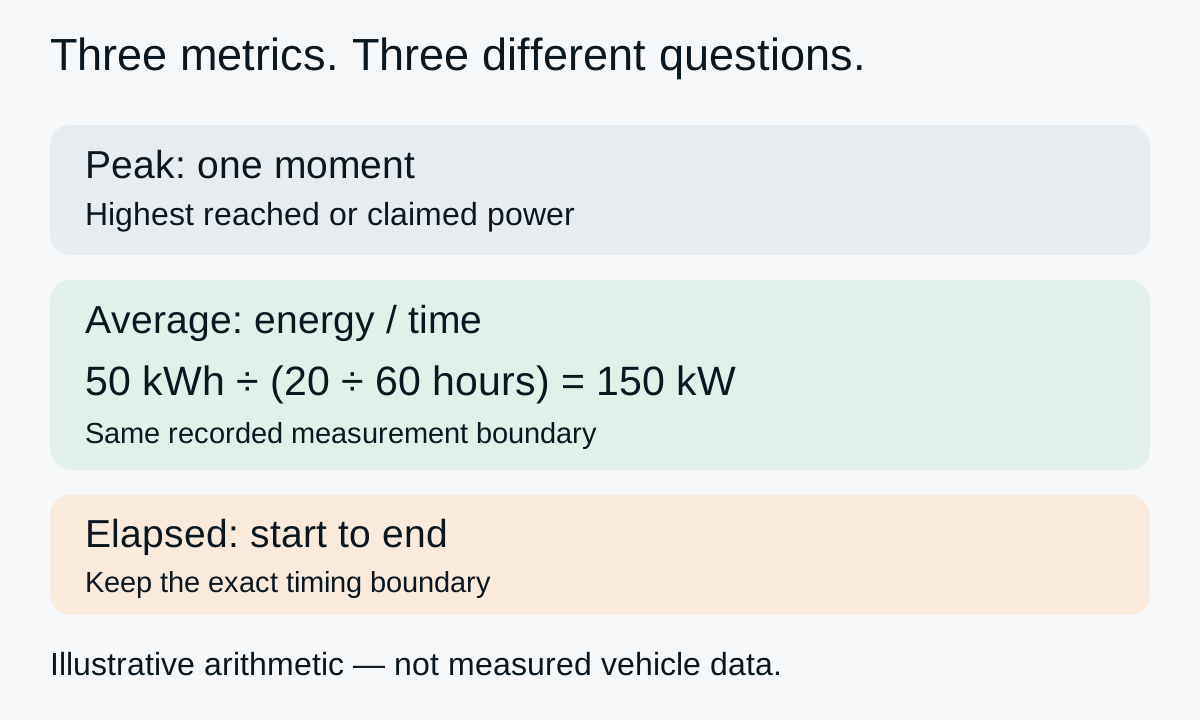
Keep the labels attached when someone sends you a result. “150 kW” could be a charger rating, a momentary display reading or an average over a recorded interval. Those are different pieces of information. Ask which one it is before putting it into the comparison sheet.
Put both vehicles on the same comparison window
A 10–80% claim and a 20–80% claim do not time the same SOC window. Neither can be directly substituted for a statement about kilometres of range added. You can retain all three as source information, but do not arrange them in one fastest-to-slowest column as if they measure the same result.
Even a shared 10–80% window does not imply equal energy or equal driving range across different battery packs. It standardizes the stated SOC endpoints, not every aspect of the vehicles. Keep pack identity visible and choose the metric that answers the buying question: time across a chosen window, energy recorded during a stop, or the wider route requirement.
Use one row per identified session or manufacturer claim, with the source type stated. This proposed worksheet is a comparison aid, not an independent test dataset.
| Comparison field | What to record | What to do if it differs or is missing |
|---|---|---|
| Vehicle | Model, trim, pack and market specification; unit identity for a unit-level test | Do not silently apply the result to another configuration |
| SOC interval | Exact start and end percentages | Keep unlike windows separate or request a matching record |
| Timer | What starts and stops the clock | State which activities the recorded time includes |
| Energy boundary | Where energy was measured, with its unit | Do not label charger-delivered energy as stored battery energy without supporting measurement |
| Power | Whether the number is a rating, observed peak or interval average | Request the complete time-power record when the distinction matters |
| Conditions | Station identity and known vehicle, temperature and preparation conditions | Show the unknowns rather than filling them with assumptions |
| Evidence | Full document, log or session record, with date and source | Keep a source claim distinct from a witnessed vehicle result |
This also helps when the evidence is incomplete. A missing temperature field does not justify inventing one, and an unlabelled screenshot does not become a complete session log merely because it shows a high number. Keep it as partial evidence and ask for the item needed to resolve the comparison.
Keep the launch claim attached to its model and footnotes
Manufacturer announcements are useful starting points, provided their scope travels with the headline. BYD's March 2025 Super e-Platform announcement describes charging claims in a named platform launch. It is not, by itself, a common-window session record for whichever export vehicle a buyer is considering. Its presence on a US-language web path also does not establish US vehicle availability.
Brochure footnotes deserve the same attention. The Qatar-market XPENG G9 brochure qualifies charging statements with test and specification context. Read those qualifications with the displayed figure. Do not extract a time from one market's brochure and apply it to a different pack or offered configuration without confirming the match.
For each proposed vehicle, retain the full source document and identify the page or record supporting the claim. Then write down the offered configuration beside it. If you cannot connect the two, you have a question for the supplier—not a verified charging specification for that unit. A comparison sheet can say “configuration match not confirmed” without dismissing the technology or overstating the evidence.
Read the conditions beside the curve
Fastned identifies state of charge, battery temperature and charger or site limitations as factors in charging speed. The practical implication is to read those conditions beside the result. A slower session should not automatically be treated as proof that a manufacturer's stated result is false, nor should a favourable demonstration be treated as the result every buyer will obtain.
Ask for the station and vehicle identities, the known starting conditions, any preparation or preconditioning record, and any interruption noted during the session. Keep measured values separate from dashboard descriptions or recollection. If software or pack details are unknown, label them that way; do not let a tidy spreadsheet hide the uncertainty.
Network compatibility is a separate question from speed once charging is established. Use the charging-standard compatibility guide for that decision instead of assuming that a connector label guarantees the intended session. This article compares performance evidence; it does not approve an adapter, charging installation or destination-market import.
Once the comparison is assembled, look for the mismatch that actually matters to your decision. An unidentified trim needs configuration evidence. Different SOC windows need a matching interval. A result without a timing definition needs the original record. Requesting the specific missing item is more useful than asking the supplier to repeat “how fast does it charge?”
Make the buying decision from the stop you actually need
Define the required stop before judging the claim. Write down the SOC window you intend to compare and whether the time allowance covers only charging or the whole visit to the station. If the recorded timer begins after connection and ends when the target SOC is reached, any queue, connection or departure time outside that boundary is not included.
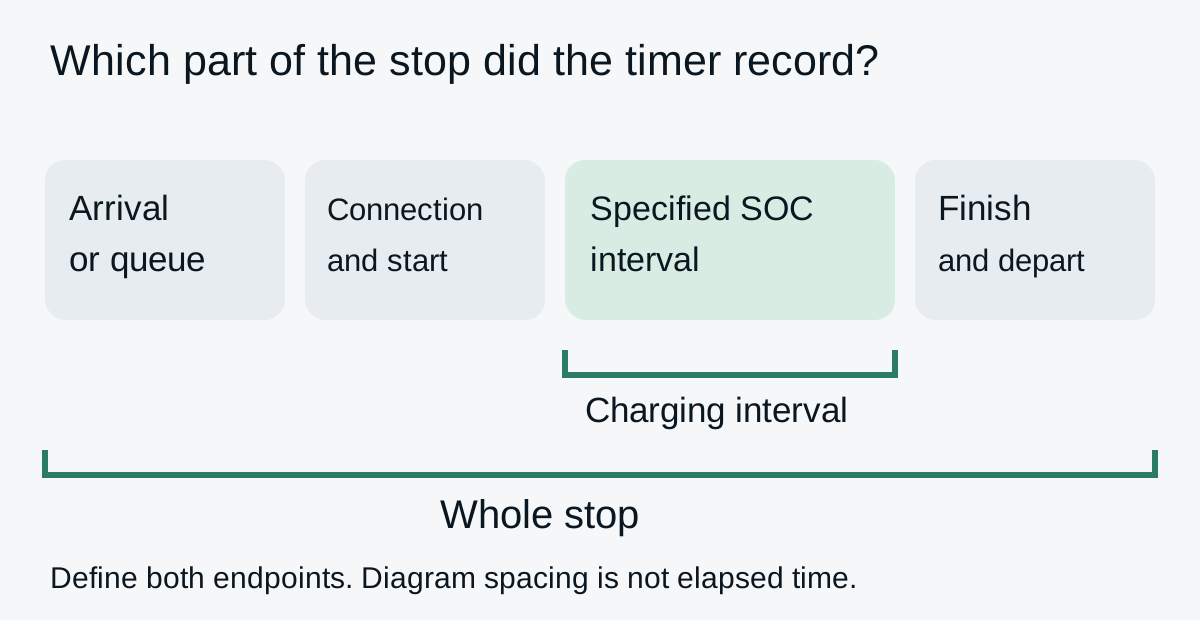
Use the Chinese EV model catalogue to identify the vehicle being considered, then attach the comparison to that exact configuration. Keep three outcomes distinct: the records support the chosen comparison; a known mismatch prevents a direct comparison; or a missing record needs clarification. None requires inventing a ranking from incomplete data.
The useful result is a documented buying question: “Can you provide a matching 10–80% record for this configuration, with the station, timer and conditions identified?” That is specific enough to move the enquiry forward. It is also honest about the difference between a promising specification and demonstrated performance for the offered vehicle.
Sources and research limits
- Fastned — Everything you always wanted to know about fast charging: general session and power-request principles; dated market rankings, connector coverage and blanket battery-life claims are not used.
- BYD — Super e-Platform launch announcement, 17 March 2025: an example of source-specific launch metrics, not proof of the offered vehicle's availability or session performance.
- XPENG — Qatar-market G9 brochure: test and configuration qualifications accompanying charging claims.
This is a desk-researched comparison method. No vehicles were road-tested or charged for this article, and the arithmetic example is not measured vehicle data.
Ask about the exact vehicle
Share the model, trim, pack and destination you are considering, together with your intended charging network, comparison window and available source records. Ask BuyChineseEVs which configuration-specific charging documents are available and which details still need confirmation. The enquiry does not establish stock, import eligibility, local compatibility or a guaranteed charging time.
Ask about the exact vehicle